
Throughout recent years, we have witnessed an increase in human migration as a result of conflict, political instability and changes in the climate. Despite the growing number of migrants and refugees, provisions to address their health needs remain inadequate and often unmet. Whilst a variety of instruments exist to assert and emphasise the importance for migrant and refugee health, the lack of shared priorities between partners and stakeholders results in poor access to healthcare and essential medicines.
In response to the growing health challenges faced by migrants and refugees, members of the M8 Alliance launched an annual Expert Meeting on Migrants’ and Refugees’ Health. This report is shaped by discussions from the second M8 Alliance Expert Meeting (Sapienza University of Rome, Italy, 15–16 June 2018) and is supported by supplementing literature to develop a framework addressing critical reflections, challenges and solutions of and for migrant and refugee health. This report aims to inform decision-making fostering a humanitarian, ethics and rights-based approach. Through a series of country-specific case studies and discussions, this report captures the most prominent themes and recommendations such as mental health, tuberculosis (TB) and best practices for increased access.
Narrative of migration: Moving lives
As a complex and social phenomenon, the process of migration has become increasingly political, with adequate healthcare often low on the list of priorities. Over the past decade, there has been an influx of migrants crossing borders, primarily due to political instability, military conflict and extreme climatic conditions. These events have been accompanied by a growing burden of disease, with data suggesting that infectious disease, accidents, injuries, musculoskeletal disorders and violence disproportionately affect migrant groups compared to long-settled populations in the European Union [1]. Amongst these health challenges, mental health disorders and TB remain a major problem. Disease prevalence varies between migrant groups, and therefore it is important to be aware of the different types of migrants that exist [1].
Whilst a refugee is a type of migrant, stark differences exist between refugees and other type of migrants. The Convention and Protocol relating to the status of Refugees defined refugees as “Individuals who, owing to a well-founded fear of being persecuted for reasons of race, religion, nationality, membership of a particular social group, or political opinion, are outside the country of their nationality, and are unable to, or owing to such fear, are unwilling to avail themselves of the protection of that country or return because of fear of persecution” [2]. Other migrant status may include international migrants, internal migrants, irregular migrants and tourists [3]. The main difference that exists between refugee populations (asylum seekers, resettled and relocated refugees) and other types of migrant groups is that refugees are survivors of persecution and multiple violent events, including war and torture, and their migration experience is forced [4]. The differences in these lived experiences may therefore have a profound effect on their overall wellbeing and in particular on their mental health [4]. In addition to categorising the type of migrant, the process of migration may also be categorized. Factors that dictate the type of migration include the following: boundary crossed (national, international, political, and administrative), duration of stay (temporary, permanent), distance (regional, national, and international) and lastly, the decision-making approach for migration [5]. The latter can be further subcategorised into voluntary, instigated or forced, or impelled [5]. Migration, both voluntary and forced, is increasing at an unprecedented rate, leaving many unanswered questions for public health. Therefore, migrant and refugee health requires a collective response, addressing health challenges by mobilizing stakeholders, trade unions and partners globally.
The migration process can increase migrant and refugees vulnerability to ill health, through increased exposure to risk factors (see Fig. 1). The process may be subcategorised into the following: pre-departure and at the border, travel and transit, host communities and return. Compulsory medical screening is often a major concern for migrants and refugees pre-departure or at the border, as unsuccessful screening could result in denial to enter their chosen host country. The purpose of screening is to address the introduction of potential health threats that may endanger the health of host populations, specifically for the case of infectious disease [6, 7]. However, the legitimacy of medical screening has been questioned, as it disregards the moral and ethical implications, and also does not adequately address diseases with latent periods [8]. The migratory journey itself affects the health of many migrants, due to physical and environmental threats, the lack of access to the most basic services, alongside increased exposure to both violence and trauma having significant repercussions on their mental health [9].
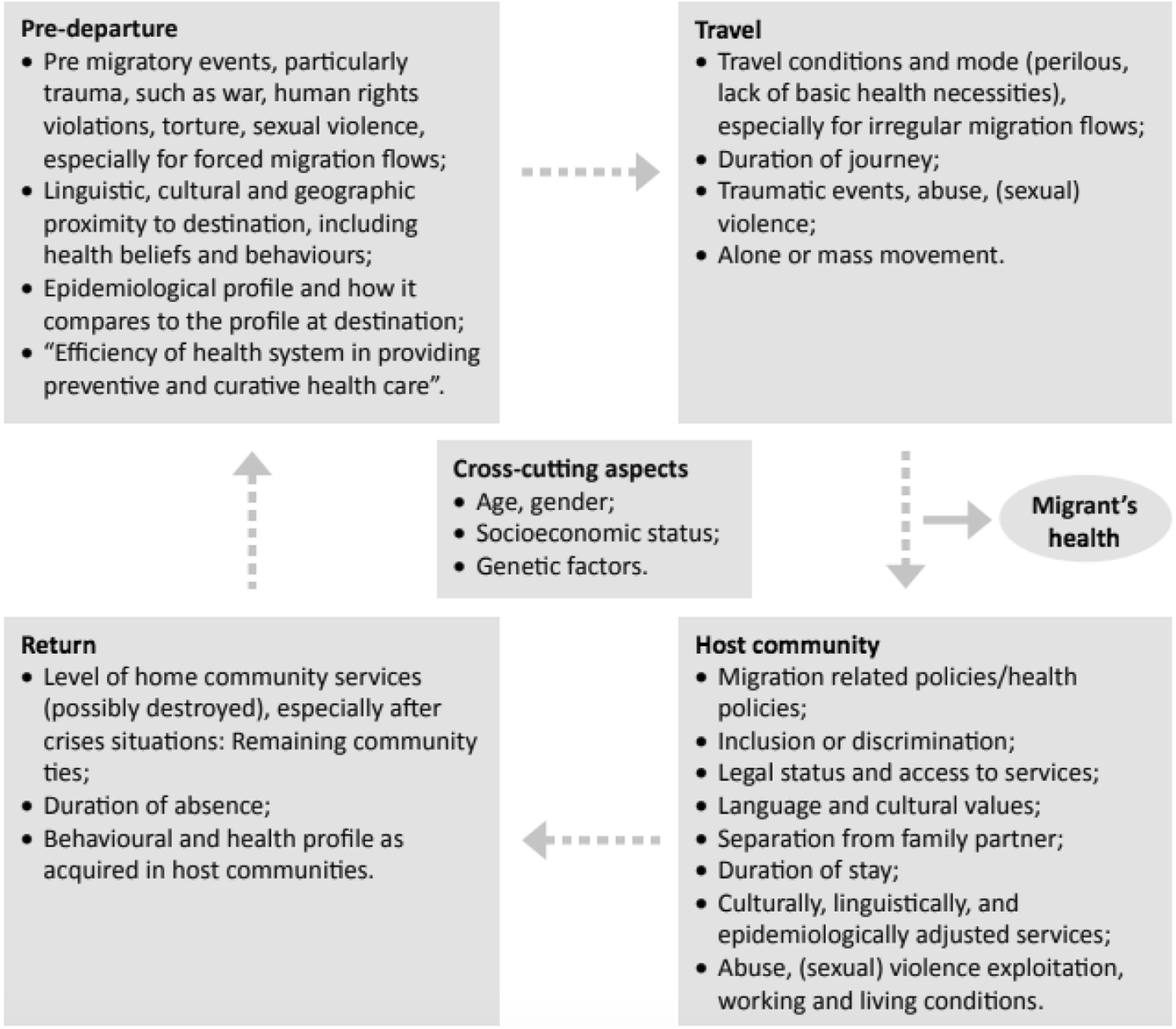
Once within the host country, there are still many obstacles hindering health for migrant populations, such as occupational health and safety. Migrants and refugees are more commonly exposed to occupational hazards via physical labour in occupations such as mining, agriculture and construction, whilst also having increased exposure to sexual exploitation [10]. Upon return to their country of origin, health problems that have been acquired in the host country may surface—this is especially true for mental health conditions, which may increase in severity [11].
Understanding the issue
The portrayal of migration in the media often leads to false beliefs, stereotypes, and negative perceptions of migrants and refugees. This widely circulating narrative often dilutes the severity of the phenomena, focusing only on negative aspects and shedding no light on the positives of migration. As a result, host societies often neglect to understand migration in its entirety (from departure to arrival and integration), especially within its political framework [1]. The Wroclaw Medical University, Poland, further explored public opinion regarding migration by Attitudes and opinions of Polish society about immigrants and refugees in Poland [12]. Results were drawn from a survey on public acceptance of refugees and migrants, including 367 respondents (of which 100 were within medical professions), conducted in cooperation with the Polish Association of Healthcare Managers (STOMOZ). Results of the survey seemed contradictory at times, indicating that many respondents perhaps misunderstood or misinterpreted the concept of migration. For instance, when asked if “every person should be able to move to another country fleeing war or prosecution” 62% of respondents answered “totally agree”, however when asked “would you feel uncomfortable if your new neighbour was an immigrant of refugee”, 54% of respondents answered “yes” [12]. This indicated that whilst respondents seemed to understand the reason for leaving, they were less receptive to the practical realities of migration.
Findings from the survey concluded that a possible reason for the negative opinions could be deduced to (1) misunderstanding of migration, (2) fear of an unknown situation or (3) stereotypes [12]. However, it is also important to note that the migrant population in Poland consists mostly of Ukrainian immigrants, who due to proximity have acclimatized well in Polish society. Similarities within the neighbouring regions, as well similarities in ethnicity, may have therefore accounted for some of the discrepancy between responses in this case [12]. Additionally, it is important to note that a rather small sample size of the Polish society were included in the survey and are thus not representative of the Polish society as a whole.